MEND
AI-Powered Journaling to support reflection and emotional awareness
ROLE
- UX/UI Design
- Frontend Dev
- Usability Testing
SKILLS
- User Research
- IA + Flows
- Accessibility
TOOLS
- Figma
- Next.js
- Tailwind
Group project focusing on UX clarity, accessibility, and testing-driven iteration.
BACKGROUND AND CONTEXT
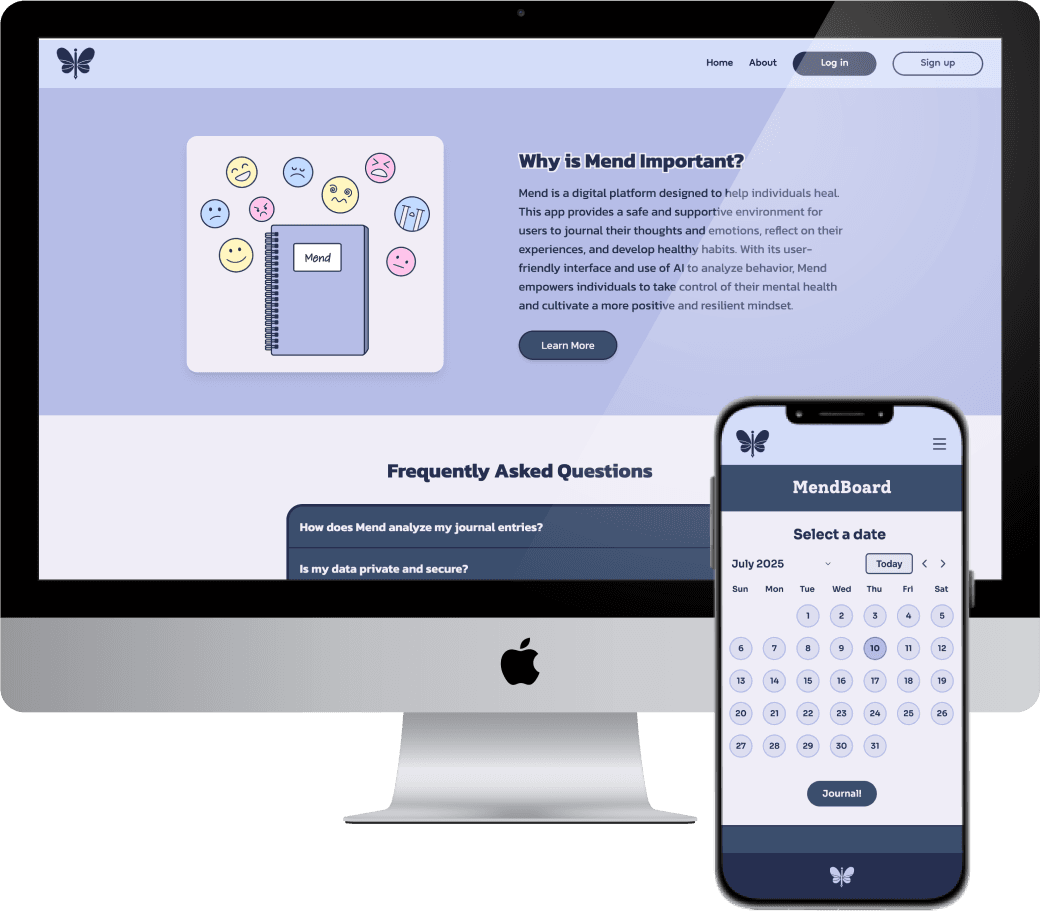
Mend is an AI-powered journaling app designed to help users reflect, track emotions, and build healthier mental wellness habits. This semester-long project focused on creating a calm, accessible journaling experience and using AI outputs to help users notice patterns across entries.
PROBLEM
Many people start journaling, but struggle to stay consistent because it feels like writing into a blank void.
Through early research, we found that many journaling tools act as static diaries: users can log feelings, but they don’t receive guidance, feedback, or an easy way to recognize trends over time. Without a reflection loop, motivation drops and journaling becomes harder to sustain.
Design challenge
How might we create a journaling experience that feels easy to start, emotionally safe to use, and helps users understand patterns across their entries — not just store them?
RESEARCH & INSIGHTS

Methods
- Interviews with 5 participants across different journaling habits
- Survey with 20+ respondents to validate patterns
- Competitive analysis of journaling and mental health apps
Key Insights → Design Responses
1) Consistency drops when journaling doesn't feel like it's "doing anything."
Response: Add a reflection loop with AI feedback and visible progress (calendar + streaks).
2) Blank-page anxiety makes writing feel overwhelming on stressful days.
Response: Guided prompts + minimalist layout to reduce friction and cognitive load.
3) Users want pattern awareness, not just entry storage.
Response: AI outputs that detect trends/correlations across entries (e.g., repeated stress triggers, mood changes over time).
PAIN POINTS
Difficulty building a consistent habit
- Users struggle to journal regularly without structure or reinforcement
- Low motivation when progress feels invisible
Lack of accessible support
Not everyone has affordable or safe mental health resources, so self-guided tools need to be approachable and inclusive.
Overwhelming UI discourages reflection
Complex layouts can increase cognitive load and reduce the likelihood of returning consistently.
PERSONAS
We created three personas representing different journaling habits and accessibility needs. Each helped guide design decisions around motivation, clarity, and emotional comfort.

Name: Emily D.
Age: 20
Occupation: Student
Goal: Build a consistent journaling habit and recognize emotional patterns.
Background: Faces academic pressure and social anxiety. Journals occasionally but struggles with consistency.
How Mend helps:
- Guided prompts reduce blank-page anxiety
- AI feedback encourages reflection after each entry
- Calendar + streaks reinforce habit-building

Name: Jason B.
Age: 36
Occupation: Manager
Goal: Manage stress and build a quick reflection habit.
Background: Long work hours, limited time. Wants low-effort tools to decompress.
How Mend helps:
- Fast journaling flow designed for 5–10 minutes
- AI feedback provides supportive reflection prompts
- Simple visuals highlight patterns without overwhelming detail

Name: Mary V.
Age: 52
Occupation: Parent
Goal: Maintain mindful journaling that supports resilience.
Background: Uses journaling as an emotional outlet and has low vision, so readability matters.
How Mend helps:
- Accessible typography + contrast for readability
- Screen-reader-friendly structure
- AI trend summaries make reflection easier over time
FEATURES
- Distraction-free journaling – Minimal UI to reduce cognitive load during emotional moments.
- AI reflection feedback – Helps users interpret individual entries and encourages continued reflection.
- Trends & correlations – AI outputs highlight recurring themes and patterns across entries over time.
- Calendar journaling – Supports consistency and makes progress visible.
- Accessibility-first – High-contrast styling, readable typography, and screen-reader-compatible structure.
SITE MAP & USER FLOW
User Flow
Site Map
IDEATION
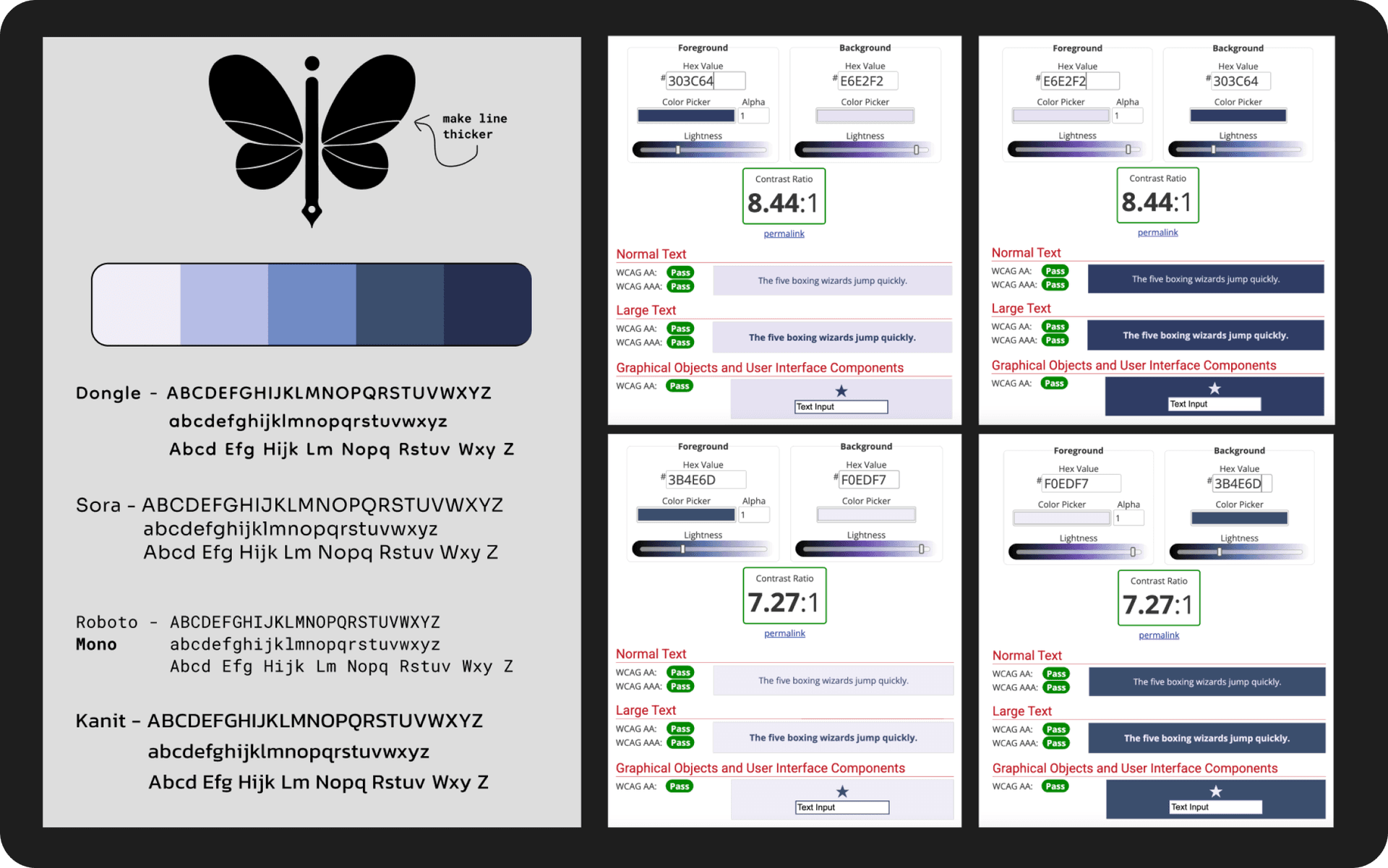
- Sketch & Explore – Drafted early ideas for layout and brand direction.
- Refine the Logo – Polished a simple, calming concept in Illustrator.
- Select Fonts & Colors – Chose readable typography and nature-inspired tones.
- Test Accessibility – Checked contrast and readability against WCAG guidelines.
- Finalize Visual System – Prioritized calm hierarchy over dense dashboards.
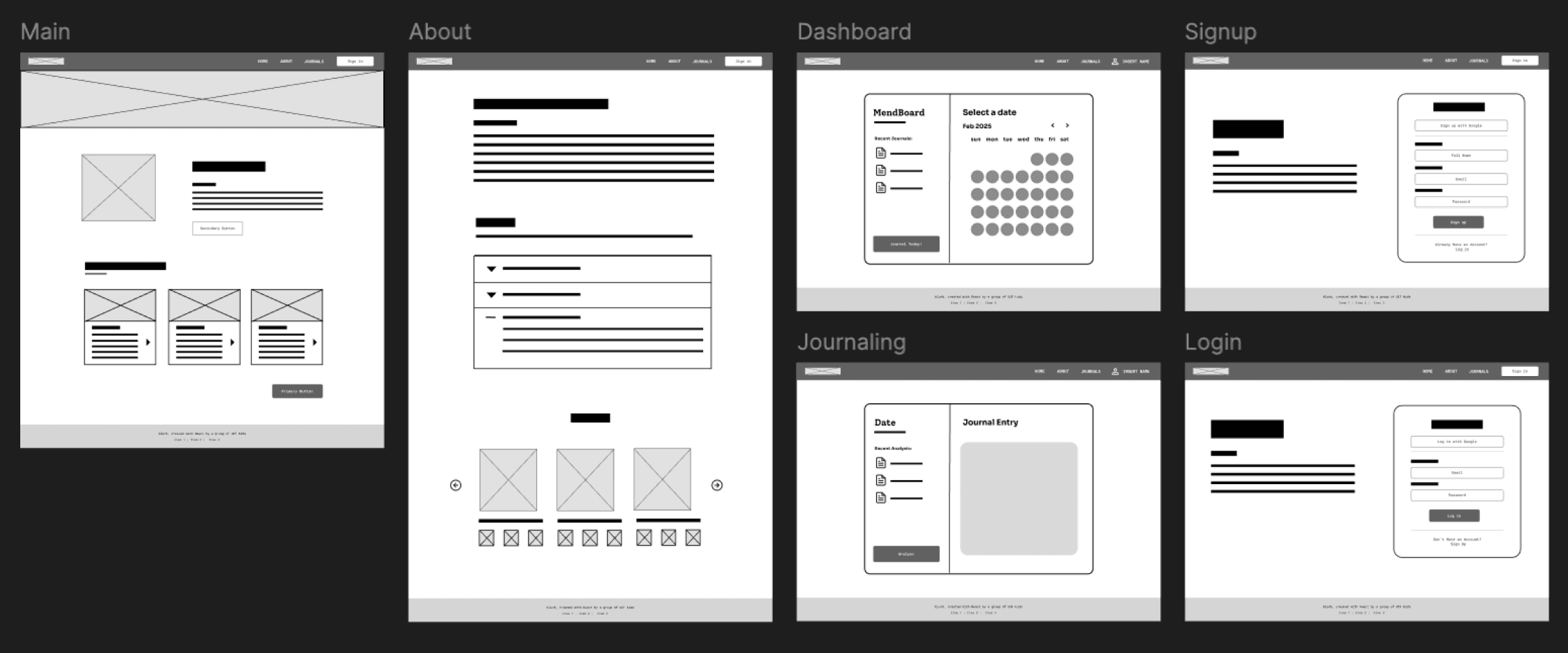
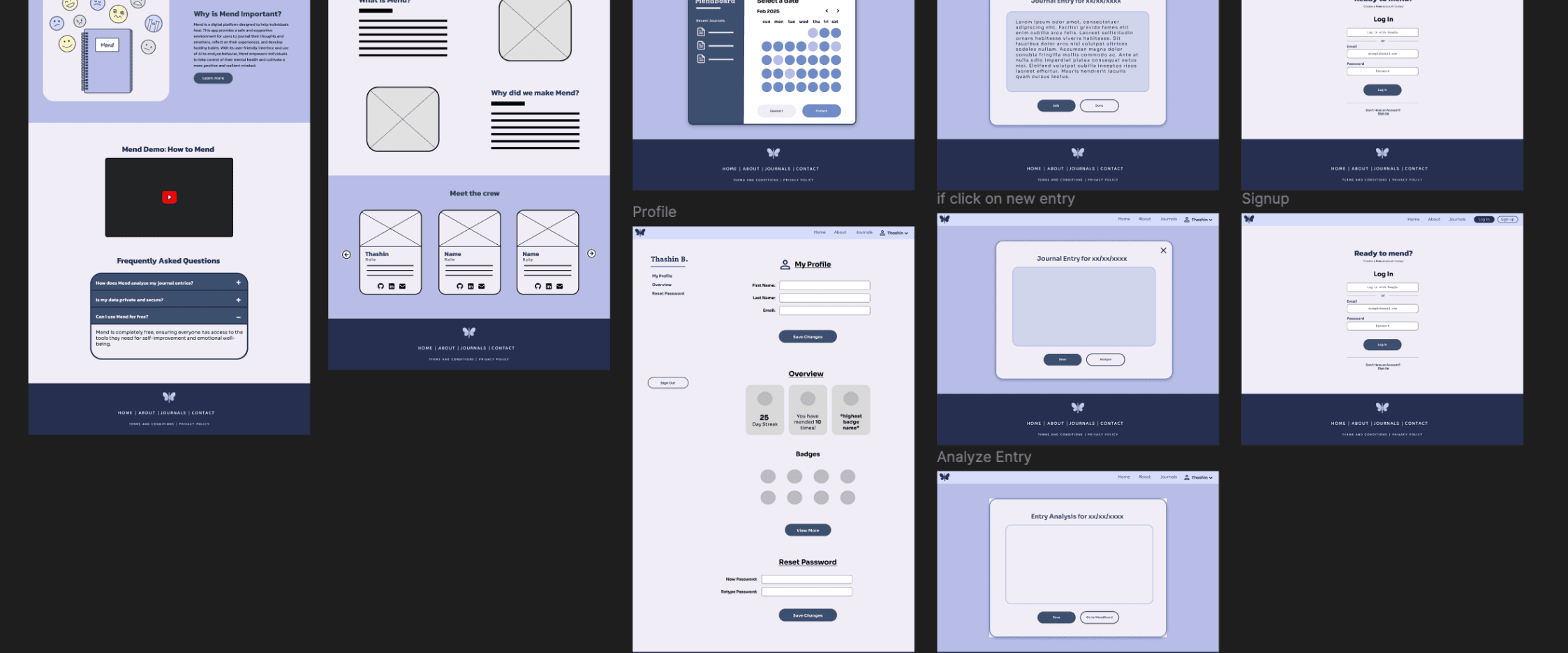
WIREFRAMES
Lo-Fidelity
Mid-Fidelity
USABILITY TESTING & ITERATION
Participants
5 usability test participants
Core tasks tested
- Write a journal entry and view AI feedback
- Review past entries and identify emotional trends
Issue 1: AI feedback wasn't immediately noticeable
Some users finished writing and assumed the experience ended after submission.
Iteration: Improved hierarchy of the feedback area, added a clearer CTA, and introduced a small reveal animation to draw attention.
Result: 80% (4/5) noticed and used AI feedback without prompting after changes.
Issue 2: Trends felt hard to interpret at a glance
Users could see mood history but wanted help understanding what it meant.
Iteration: Added AI-generated pattern summaries (e.g., recurring themes, possible correlations across days) alongside visuals.
Next measure: Time-on-task + confidence rating to validate comprehension improvements more precisely.
CODED PROTOTYPE
Prototype focuses on the core journaling flow, AI feedback visibility, and trend reflection experience.
OUTCOME & IMPACT
- Validated key flow clarity: After iteration, 80% (4/5) participants engaged with AI feedback without needing hints.
- Improved reflection support: AI outputs moved beyond single-entry summaries to highlight trends/correlations across entries over time.
- Accessible by design: Contrast-tested visuals, readable typography, and screen-reader-friendly structure supported inclusive journaling.
If I continued this project, I would run a longer-term study (2–4 weeks) to evaluate retention (streak consistency), perceived helpfulness, and emotional comfort over time.
REFLECTION
Working on Mend taught me how much UX details matter in emotionally sensitive products. Usability testing showed that even when a feature exists (like AI feedback), users may miss it without strong hierarchy and clear cues. Iterating based on real participant behavior helped me prioritize clarity, accessibility, and emotional comfort over adding more features. This project reinforced my goal as a student designer: to build experiences that feel calm, inclusive, and genuinely supportive.